Executive summary · Enhance Fitness
Promising — evidence incomplete
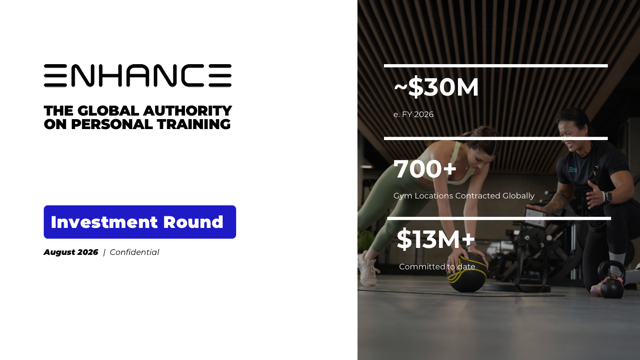
Assessed as a growth-stage (Series B/C-equivalent) raise: the company has already raised $30M+ from institutional investors (Global Ventures, Stride, Mohammed Bin Rashid Innovation Fund), reports ~$30M FY2026e revenue and operates in five markets. The deck tells a coherent full-stack software-plus-operations story for personal training with eight years of operating history and founder-reported audited revenue growth from $0.9M (2019) to $19.4M (2025). What is missing is the mechanics of the round itself — no valuation, no use-of-funds breakdown, no cap table — and the substantiation an investor would need to underwrite a $20M check against a 2026–2030 plan that scales revenue 20x. The club-level economics are compelling as shown, but the sample (one live P&L, 16 clubs in a cohort chart) is thin relative to the claimed base of 700+ software clients and the US expansion thesis rests heavily on two inbound relationships.
A pitch deck proves what the founder states — not that it is objectively true. Founder-reported claims are labelled, missing information stays missing, contradictions stay contested.
Highest-leverage improvement
Add a clear, specific use-of-funds and round-terms slide (valuation, allocation, milestones) — this is the single gap most likely to stall a growth-stage investor from moving past a first meeting.
The sixty-second read
- Strongest point · Clear, differentiated full-stack thesis (software + operations + data) with a defensible 'operating system' analogy to hotel PMS
- Biggest concern · The 2027–2030 plan (10x+ revenue growth) is a projection carrying most of the investment thesis, despite 'proven, not projected' framing
- Second concern · US expansion — the stated use of the $20M — rests on a thin sample: one multi-club deal and one additional inbound call, not a validated pipeline
As ranked by the engine — the full case for each is below.
Can I raise with this deck today?
This deck can open growth-stage investor conversations on the strength of traction and name-brand backers, but it is not yet complete enough to carry a term sheet — the gaps are mostly about round mechanics and diligence substantiation rather than business-model validity.
What blocks fundraising
- • No valuation or round terms disclosed
- • No use-of-funds breakdown for the $20M ask
- • Unit economics 'full build' is referenced but not included
- • Club-level margin (25%) and regional EBITDA (16%) are shown without a reconciling explanation
- • No competitive landscape despite a 'category does not exist' claim
- • US expansion thesis rests on two inbound relationships, one of which is not confirmed as contracted
Fixable today
- • Add a use-of-funds slide with specific allocations
- • Disclose valuation/terms for the round
- • Add a TAM/SAM/SOM breakdown instead of the single $42B figure
- • Add a one-slide competitive landscape
- • Clarify the relationship between club-level margin and regional EBITDA
Needs customer evidence
- • Signed contract or letter of intent for the 53-club PA conversion
- • Retention/renewal data across the club base over multiple years
- • Independent customer references from gym operators
Needs a change to the business
- • None identified that require altering the core business model; the main gap is evidentiary completeness and round-structure disclosure rather than a flawed model
Work remaining · Moderate: the core narrative and traction data are strong, but round-structure disclosure, a competitive framing, and contract-level substantiation of the US pipeline are needed before most growth investors would issue a term sheet.
What will hurt the raise
- Mature club net contribution is +25% (single club P&L) — conflicts with Consolidated regional EBITDA is stated as 16% (FY2025, audited) on the same slideModerate
- The deck repeatedly frames figures as 'Proven, not projected' — conflicts with The bulk of the investment case (2027–2030 revenue growing to $400M+) is explicitly labeled a 'management plan' / projectionModerate
- The 2027–2030 plan (10x+ revenue growth) is a projection carrying most of the investment thesis, despite 'proven, not projected' framing
- US expansion — the stated use of the $20M — rests on a thin sample: one multi-club deal and one additional inbound call, not a validated pipeline
- Founders' domain background is in media/streaming, not fitness; the 8-year operating history mitigates but does not eliminate execution-transfer risk into a new vertical at much larger scale
- No competitive landscape is presented despite the category-creation claim, raising the risk of unexamined competitive threats (existing gym software/PT platforms)
- The sunset of the 'mobile at-home' product line is disclosed without explanation — a past pivot that is not addressed
- Central cost leverage claim ($72K to $18K per club) is asserted without the operational detail behind it
What to strengthen
What the deck demonstrates
- Audited revenue growth from $0.9M (2019) to $19.4M (2025), a 65% CAGR, is stated and labeled 'audited financials'High confidenceSlide 9: 'Audited financials FY2019–2025, USD'
- A single mature UAE club's monthly P&L is shown in detail with a 25% net marginModerate confidenceSlide 7: 'costs estimated' label qualifies the cockpit figures as founder-generated, not externally verified
- The company has named institutional backers from a prior raiseHigh confidenceSlide 14: 'Backed to date by Global Ventures, Stride and the Mohammed Bin Rashid Innovation Fund'
- Leadership has senior operating experience in large media/streaming businesses, not originally in fitnessHigh confidenceSlide 13: CEO/COO/CFO bios reference Deezer, WBD, Disney, Cambridge
- The 2027–2030 growth plan to $400M revenue and $80M EBITDA is explicitly labeled a management plan/projectionHigh confidenceSlide 10: 'Growth targets per management plan'
What investors may infer
- Investors may infer the business is largely de-risked given the 'Proven, not projected' framing, even though most future value creation depends on an unproven 4-year US scale-upModerate confidenceSlide 5 and Slide 9 repeat 'proven, not projected' while Slide 10's figures are labeled 'plan'
- Investors may infer club-level profitability is consistent across the full base, though only 16 UAE clubs and one P&L are shown against a claimed 700+ gym software footprintModerate confidenceSlide 8 shows 16 clubs; Slide 6 claims '700+ gyms contracted'
- Investors may infer the $42B TAM figure is conservative or well-vetted, though the deck states other market-sizing figures were deliberately withheldLow confidenceSlide 2: 'We keep one number from the market-size stack on purpose'
Missing evidence
- MissingFull audited financial statements (not just the summary chart)
- MissingCap table and current ownership structure
- MissingValuation or terms being offered for the $20M round
- MissingUse-of-funds breakdown beyond general categories
- MissingSigned contract or term sheet for the 53-club Pennsylvania conversion
- MissingCompetitive landscape analysis (e.g., Mindbody, Exercise.com, regional players)
- MissingChurn/retention data for clubs and trainers over time
- MissingThe referenced 'full unit economics build' said to be in the appendix
Questions investors will ask
- 1.What valuation and terms are you offering for this $20M round, and is any of it already committed?
- 2.Is the 53-club Pennsylvania deal under signed contract, and on what terms (revenue share, exclusivity, duration)?
- 3.How should we reconcile the single club's +25% net margin with the 16% regional EBITDA figure?
- 4.What is club and trainer churn/retention over multiple years, not just the mature-club snapshot?
- 5.Who do you consider competitors, and why hasn't a similar full-stack model scaled elsewhere?
Investment impact
The deck builds genuine confidence in the operating model and historical growth trajectory, but an investor cannot move to term sheet without round mechanics (valuation, use of funds, cap table) and corroboration of the thin evidence base behind the US scale-up (one contract, one inbound call) that the $20M is meant to fund.
- Clear, differentiated full-stack thesis (software + operations + data) with a defensible 'operating system' analogy to hotel PMS
- Eight-year operating history with founder-reported audited revenue growth from $0.9M to $19.4M
- Granular club-level economics presented with specific, falsifiable numbers rather than vague claims
- Named institutional backers (Global Ventures, Stride, MBRIF) lend external credibility
- Experienced leadership team with a track record scaling large media/streaming businesses
- Cohort curve showing new clubs ramping from $15K to $125K/month gives a believable growth mechanism
Market-sizing methodology (SAM/SOM)
Competitive landscape
Use of funds
Valuation / round terms
Contract status for the PA deal
Full unit economics build
What to do next
The first three are near-certain in the first meeting.
- 1.What valuation and terms are you offering for this $20M round, and is any capital already committed?
- 2.Walk us through the use of funds — specifically what drives the jump to 100 US clubs by year-end 2026?
- 3.Is the 53-club Pennsylvania deal under signed contract, and what are its terms (revenue share, length, exclusivity)?
- 4.How do you reconcile the single club's +25% net margin with the 16% regional EBITDA figure shown on the same slide?
- 5.Who do you consider competitors in PT software/operations, and why hasn't this model been built or scaled by an incumbent?
- 6.What happened to the mobile at-home product line, and what did that teach you operationally?
- 7.What is club and trainer churn/retention over multiple years across the full operated base, not just the July 2026 snapshot?
- 8.What is the founders' direct fitness-industry background beyond building Enhance since 2018?
- 9.How sensitive is the 2027–2030 plan to delays or underperformance in the US rollout?
- 10.What is the current cap table and ownership breakdown post this round?
Standard materials investors request after a first meeting — normal process, not a weakness of the deck. Have them ready in the data room.
- Data roomFull audited financial statements and auditor opinion letters
- Data roomCap table and equity/option ledger
- Data roomSigned customer/franchise contracts (including the Pennsylvania 53-club agreement)
- Data roomLegal and regulatory review across five operating jurisdictions (UAE, KSA, Bahrain, Qatar, USA)
- Data roomBoard composition, governance structure and shareholder agreements
- Data roomDetailed financial model with assumptions underlying the 2027–2030 plan
- Data roomBackground/reference checks on founders and GMs
- Data roomIP and technology architecture review of the AI platform
- Data roomCustomer reference calls with gym operators
- Add a use-of-funds slide with specific dollar allocations and milestones
- Disclose valuation and round terms
- Expand the $42B market figure into a SAM/SOM breakdown with sourcing
- Add a competitive landscape slide addressing adjacent players
- Clarify the relationship between club-level margin and regional EBITDA figures
- Disclose the status (signed/LOI/verbal) of the Pennsylvania 53-club deal
- Include or reference-share the full unit economics build mentioned as being in the appendix
- Briefly address the mobile at-home product sunset and what was learned
- Add multi-year churn/retention metrics for clubs and trainers
- Separate 'proven' historical results from 'projected' future plan more explicitly in slide framing
Fix before sending
- • Add use-of-funds and round-terms slide
- • Add SAM/SOM breakdown to market sizing
- • Add a competitive landscape slide
- • Reconcile club margin vs. regional EBITDA presentation
Before the first meeting
- • Prepare cap table and ownership summary
- • Prepare contract/LOI documentation for the PA deal
- • Prepare multi-year churn/retention data
- • Prepare the referenced full unit economics appendix
For diligence
- • Full audited financial statements
- • Legal/regulatory review across five jurisdictions
- • Signed customer and franchise contracts
- • Board and governance documentation
- • Detailed financial model underlying 2027–2030 plan
- • Reference checks on founders and GMs
The evidence
The company shows eight years of direct PT floor operations and a leadership team with strong (if non-fitness-specific) scale-up pedigree from media and streaming. This supports execution capability but leaves open questions about domain-specific risk at a 10x-larger US scale.
- Founder-reported 8 years running PT floors end-to-end since 2018 · Slide 3, 5No third-party verification of operating history or client outcomes is provided.
- Founder-reported Leadership team built $500M+ revenue businesses in media/streaming · Slide 13Relevant but not fitness-specific experience; no prior fitness-industry executive roles disclosed for founders.
The deck asserts a $42B global PT market but deliberately withholds the full sizing methodology, and frames inbound demand (two relationships) as evidence that market pull already exists.
- Founder-reported $42B global PT revenue market · Slide 2No source, methodology, or SAM/SOM breakdown is given; figure cannot be independently assessed.
- Founder-reported Inbound demand from US gym operators without active sales outreach · Slide 11Anecdotal, two data points; no broader pipeline or conversion-rate evidence provided.
The deck claims the full-stack software-plus-operations category does not yet exist, but provides no competitive landscape or analysis of adjacent incumbents.
- Founder-reported 'This category does not exist yet. We are building it, and we intend to own it.' · Slide 4No competitor names, comparison, or defensibility analysis beyond the data-moat claim is included.
Club-level P&L and multi-year revenue growth are shown with specific figures, offering concrete (if founder-reported and partially estimated) evidence of unit profitability and historical scale.
- Founder-reported Revenue grew from $0.9M (2019) to $19.4M (2025), 65% CAGR, labeled audited · Slide 9Audit opinion/statements themselves are not included in the deck; label is a founder claim.
- Founder-reported Single UAE club generates $113K monthly revenue with +25% net margin · Slide 7Explicitly labeled as estimated costs from an internal cockpit, not externally verified.
- Contested Club net contribution and regional EBITDA figures shown together · Slide 7The relationship between club-level and regional figures is not explained, leaving the scope of 'consolidates to' ambiguous.
The ask is clearly stated at $20M with named prior institutional backers, but the deck does not disclose valuation, terms, or a specific use-of-funds breakdown, which are required for underwriting the investment decision.
- Founder-reported $30M+ raised to date, backed by Global Ventures, Stride and MBRIF · Slide 14No cap table or breakdown of prior round terms/ownership is provided.
- Founder-reported $20M ask to fund US trainer recruitment, leadership teams, AI automation and club launch capacity · Slide 14No dollar allocation, timeline, or milestone attached to the categories listed; valuation/terms are entirely absent.
A pitch deck proves what the founder states, not that it is objectively true. In the production review, founder-reported claims are labelled as such, missing information is left missing, and contradictions are left contested. Model: claude-sonnet-5.
Was this review worth your time?